 October 12, 2025 - 3292 views
The Northern Eye International Photography Festival has made its triumphant return to Colwyn Bay, bringing together photographers, enthusiasts, and the community for a weekend filled with creativity and inspiration.
This biennial festival, supported by the UK Shared Prosperity Fund and the Bay of Colwyn Town Council, offers a unique opportunity for attendees to engage with established photographers, participate in workshops, and explore captivating exhibitions.
++ PODCAST TRANSCRIPTION ++
Capturing Moments: Inside the Northern Eye
Intro:
This is the Northern Eye International Photography Festival, generously supported by the UK Shared Prosperity Fund and the Bay of Colwyn Town Council.
Simon:
This is Simon, this is Bayside and a special podcast today to mark the Northern Eye Photography Festival which is back in Colwyn Bay. Now it's quite a weekend, it's a little bit blustery, it's a little bit wet, but that is not going to dampen the spirits of all the delegates coming here to Oriel Colwyn. I can only describe the atmosphere as incredible. I'm looking at the layout of the exhibition room with so many pictures and there's so much to do here this weekend. We're going to be having our Speaker’s Weekend, which is happening today and also tomorrow with talks and presentations by established photographers. We've got exhibitions, pop up events across Colwyn Bay and lots of social activities as well. If you didn't know anything about the Northern Eye, it's a biennial festival of photography, it's based this year in Colwyn Bay. It's organised by Oriel Colwyn and the wonderful curator,
Paul Sampson, who I'm sure we will talk to a little bit later on. And we're in the Theatr
Photography Festival, which is based in Aberystwyth, so there is effectively a photography festival in Wales every year. Northern Eye in odd years and the Eye Festival in even years. I'm going to see whether we can get 5 minutes or a few minutes with Paul Sampson ahead of the festival beginning. I know he's incredibly busy so we'll see if we can sidestep him now and have a chat.
Paul, how's it all going?
Paul Sampson – Oriel Colwyn Curator:
It's great to see so many people here in the middle of Colwyn Bay on the stormiest day in the world. Nice to have so many people here in Oriel Colwyn, Theatr Colwyn, Colwyn Bay, that are all passionate about photography. This is all about sharing as you said before, then in the evening we all vacate to the local curry house and there's a free for all where, 50 60, or 70 people just enjoy a social evening. And it's about being social, it's about being friendly, it's about being inclusive.
Simon:
I know a lot of people have come from quite a distance in the storm. Who am I talking to please?
Nigel:
My name's Nigel and I've come from just this side of Ludlow. I came up yesterday for the photography workshop, which was absolutely brilliant. I know the weather wasn't great, but I think Eddie who ran the workshop said there's no such thing as fair weather photographers. And to be honest, it made it really atmospheric, really moody. We all got wet but had a fantastic time. It makes it a bit more dramatic. I guess if the sun was shining, they would be like holiday pictures, wouldn't they? But because of the rain, it just made it really, really atmospheric and Eddie was a fantastic tutor. He shared a lot of his knowledge and information with us, but I’m also really looking forward to today. Fantastic lineup of speakers.
Simon:
Yeah, brilliant. Who's on the agenda then? Who are you looking forward to today?
Nigel:
I've got to say Martin Parr, haven't I? He’s a huge name and one of the most famous people in photography, British photography anyway. So really looking forward to that. But I guess one of the great things about this festival is tonight we'll all go for a curry, and you'll be sitting in the curry house with some of these fantastic names. We’ve read their books, we’ve seen all their pictures and we're sitting there having curry with them tonight and they'll be talking to us at the interval and sharing their love and passion for photography.
Simon:
When you come away from here, do you come away with some top tips and some inspiration?
Nigel:
I'm not sure it's about the technical side, but that passion to just start another project or think about what pictures you can take or just rethink. We all take a lot of pictures and sometimes we get a little bit into a routine, into a rut. A lot of the photographers here offer something different and it kind of breaks you out of that and makes you see a different way of looking at something. I'm really going to take that away with me.
Simon:
Is this your first time?
Nigel:
No, I've been for many years. It is just the best festival, just because of that intimacy with the guests and the speakers and just the fantastic lineup. They are really great speakers. They are industry legends but also some emerging talent that makes you go wow, can they stop that? You know, it’s just too good.
Simon:
So, what's your name?
David:
David Bennett and I'm from Manchester.
Simon:
What is the highlight today for you?
David:
It's really the creativity, meeting new people. But I also, as an educator, I enjoy passing the skills on and just sharing the journey as it were.
Holly-Marie Cato – First Speaker on Saturday:
Hi, I'm Holly-Marie Cato. I'm a photographer from London. My work is mainly about people and spaces. I studied to be an architect and often that comes out in my work because of my observation in how people use space, specifically the built environment. I feel very fortunate that my camera's taken me to some amazing places and it's also become the biggest excuse to connect with people. I never really feel lost when I have my camera because I have a reason to explore and if someone asks me, why have I taken that picture? It's not something to shy away from. Often, it's a conversation starter. The camera's the beginning of so many nice human interactions. I've ended up turning the camera inwards and photographing subject matters and stories that are closer to home. I've been documenting my uncle stepping down as bishop at his church and photographing that wider church community. Then travelling back to where my great grandparents lived in the Blue Mountains of Jamaica and documenting homes and communities and the people that still remain in this very rural and quickly decimating community in the mountains.
This is my first time in Wales, and everyone is so nice. If you make eye contact with someone, they're smiling or they're saying hello, and coming from London, that doesn't happen. We're in our own world. I'm not saying people are meaner, but because we're so much more fast paced and busy, we don't take the time to actually look at people and greet them in the same way. The weather's been bad, but the vibes have been good, and this photography festival just feels alive. There are so many people passionate about photography, willing to connect, willing to share and also give me future ideas for projects that I haven't done yet. Because sometimes we're often working in silos, we're working in isolation when we're building bodies of work, when we're thinking about it or editing it down. Coming here and being able to share that work with a wider community who aren't familiar with what you’re talking about is so useful in finding out how sequences work, how storytelling could be refined.
I shared today a body of work that I've never shared before to an audience who was so receptive to it. Not only did that make me take that work out of my archive and really look at it and look at it with fresh eyes and talk about it. I then feed off the response that I'm getting and that's so important and it should be a part of my practise more.
Simon:
It's been quite a morning for speakers and talking to lots of attendees here. We're having an absolutely fantastic time. Just off the stage is Peter Caton, who I was reading can be described as a documentary photographer with a social conscience. Would you say Peter that is an apt description of you?
Humanitarian photographer that works exclusively with some of the most deprived areas in the world.
Simon:
Now your presentation was talking about and charting the plight of the South Sudanese. Some very dramatic pictures. Take me through what we saw.
Peter Caton:
It was just post Covid and I was stuck in Kenya for five months due to Covid and suddenly I had all this work in South Sudan. I hadn't been to South Sudan before and then I was told to go to the flooding while I was there. And from that moment on I realised, because of the remote areas that I was going to, they were totally underwater. Large communities living life amongst floods that would not recede. I realised that I had my own responsibility to make sure that I documented this situation because nobody was talking about it, nobody was publishing any work on it, there was very little information on it and yet I was seeing a terrible situation unfold.
Simon:
Do you think that the style of your photography instils people to sit up and take notice?
Peter Caton:
Well, because I use studio lighting, particularly in this story. The beautiful South Sudanese complexion is extremely dark. It's some of the darkest skin in all of Africa. And, due to security, you're having to photograph in the middle of the day, you're not allowed to photograph in the golden hours as much as you would like to. So, I'm having to use flash and I'm combining that with a Hasselblad to create studio kind of quality images. And in this way, when I have exhibitions, I can blow them up nice and big and really get some beautiful detail and colours. That's what I use to get maximum exposure. And why not? Why don't we have it beautiful? Why? Because they are people who are living a difficult, challenging existence. Why do we have to always portray them in this kind of pitiful way? Why can't we make them look beautiful?
It's not about me and my work. It's about the story. I need people to realise what is going on in South Sudan. South Sudan has had their budgets cut from the UN for consecutive years now, for the past five years. There is a donor fatigue, if you like, in South Sudan. So, the money that was once there and flooding into the country to help these people is no longer there anymore. And we're having to find other ways of raising money for these people, which is through private donors.
I'm shooting a lot for charities which are raising money for these communities and so it's incredibly important that I get to show this work to as many people as possible. That as many people as possible are made aware. They can tell their friends and family and communities about it and we can put this situation on the map because it's one of the first places in the world where you've got a permanent mass displacement of humanity due to climate change. It's the very first example of it and it could be something that we see widespread around the world. So, people need to take note now.
Simon:
Very powerful message. Thank you so much for talking to us today.
Peter Caton:
I feel like Bob Geldof. Thank you very much.
Thanks Peter.
A car.
Simon:
[Laughs] What's motivated you to get involved and sign up again?
Attendee:
Well, we live on Anglesey, so that's half an hour away. It seemed like an opportunity we shouldn't miss.
Simon:
Was there anything unexpected that you discovered, anything that caught your eye?
I found Martin Parr a lot more funny than I expected to be honest.
Simon:
He's quite a legend, isn't he?
Attendee:
Oh yes. I researched and discovered that he holds the Guinness Book of Records for the photographer having the most concurrent exhibitions at any one time. 41 apparently.
Simon:
And quite a few books as well, I think.
Attendee:
120, 130. Very knowledgeable.
Simon:
Quite unbelievable. And always a thread of humour going through them all.
Attendee:
Indeed, yes.
Simon:
So, what's brought you to the festival this year, sir?
Attendee:
Just to see what's going on, get a chance to see and talk to different photographers, see what people are doing at the moment, current projects and stuff. It's just nice to have a look around.
Would you come back here again?
Attendee:
Yeah, I would. I think they say it's every two years and not too far away, so I don't need to worry about the travel time. It’s brilliant.
Simon:
Thanks for talking to me.
So, what are you looking forward to today then?
I'm excited to hear Kyle McDougall talk of his photography because I've watched him for a while. His work is really how I got into film and understanding film. So, his talk.
Attendee 3:
On Friday we learnt about a new way of developing film using seaweed as a fixer. That was quite the new thing. And I think as well, people who have got the same interests and being able to talk to them, because I don't know much, it's my son who does. It was amazing watching him on Friday being able to talk to somebody at the same level but also learning new things as well.
Simon:
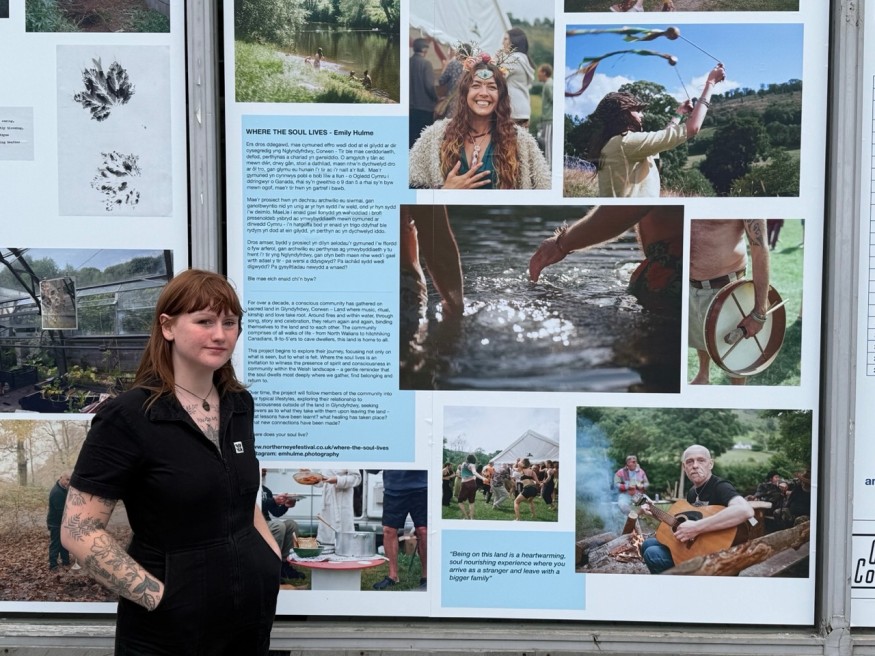
So, we've actually just taken a break from the Northern Eye. We've just come out of Oriel Colwyn, and we've come down onto Station Road and what building is this?
It's the old Peacocks building.
Simon:
Right. Now, correct me if I'm wrong, but you work with Paul, don't you?
Emily Hulme:
I do. I've been working for Paul for about two years and this week I finally put up some of my own pictures.
Simon:
We'll have a look at your work in a second. But tell me how all of this came about then. Because of the SPF? The Shared Prosperity Fund is involved in here somewhere along the way.
Emily Hulme:
Yes, when I first saw the job, I was just working as a receptionist. I didn't really know much about photography and this job came up and I thought, gosh, that sounds bizarre. I didn't really know what it meant or what it entailed, or I didn't know what curation was. I just thought people put up pictures and they looked good. I didn't know there was anything behind it and I started the week before the Northern Eye two years ago and suddenly thought, wow, this is a whole world that I just unlocked. And since then, I've been hooked. Me and Paul work so great as a team. We're very coordinated, we get on really well. It sounds so horribly cringy, but we do seriously think the same.
Simon:
Were you into photography before you applied for the job? Do you have an interest in it?
Emily Hulme:
A little bit. I'd only just got the camera that my grandad left me, and I didn't know anything about photography. I didn't study photography. I dropped out of college, where I was studying art, before we got to look at photography. Then I went for a walk with this camera around Ogwen Valley in Snowdonia and I opened the back of it, and I didn't know what film was. I took it to Cambrian in Colwyn Bay, the camera shop, and said there's something in the camera can you get it out? That was my first introduction to film. I got the photos back and ever since then I've been using that camera. That's almost two years ago.
Simon:
Now looking at your images here. We're outside Peacock's and this is your exhibition. Is this the first time this has ever happened?
Emily Hulme:
This is the first time ever.
It's impressive. It's on one panel and the images are great. Do you want to just take me through what the exhibition is about and some of the stories behind some of the pictures?
Emily Hulme:
Yeah sure. The project is called ‘Where the Soul Lives’. Originally, I was inspired by
Simon:
Well, it's very hard to convey photographs of this depth and meaning on a podcast. I suggest that if you're listening to this and you want to come down to the old Peacock's building on Station Road, come down and see Emily’s exhibition. It's called ‘Where the Soul Lives’. It's marked up from Emily Hulme and it's just absolutely brilliant, and it's just been a pleasure to talk to you today.
Emily Hulme:
Thank you.
Simon:
And continued success in your role at Oriel Colwyn.
Emily Hulme:
Thank you so much.
Simon:
An incredibly powerful presentation has set the scene today. I'm joined by Margaret Mitchell. Hello, Margaret.
Margaret Mitchell – First Speaker on Sunday
Hello.
Simon:
Can you tell me a little bit about the work that you do?
Margaret Mitchell:
I think my work has been quite varied in some ways but a lot of the work that I was showing today is based around social issues, but with a large psychological element as well. As I was saying in the presentation, I'm interested in talking about the situations of people's lives, but very much also about how they feel about the interior of life. So not just if you've had housing paucity but also how does that affect you? For example, I would hope, because I know that a lot of the work that I'm showing is really quite emotive work. I would hope that there's a sense of identity sometimes with people. I have a lot of people come up to me and actually talk to me about their own histories. But also, the people who don't understand the kind of lives that other people have in society, that they perhaps go away understanding a little bit more. They've been let into someone's life. It's a little bit educational and then hopefully, there's an element of activism within it, but it's a quiet activism.
I think it's really important that work gets seen in the right places. I've had work from ‘In This place’ shown in the parliamentary offices in Paris. That followed the exhibition over there, and they came, saw it and wanted to actually display it for a couple of years. So that was really good because what you're doing is getting the work in front of the people who do actually have power. Some of the work from ‘As The Day Closes’ was shown at the Scottish Parliament, and they had a member’s debate. The work that I did contributed to that members debate because of the stories that were presented visually.
Simon:
So, in terms of an event like this, how important do you think the Northern Eye is on the photography scene? Is it something that inspires and contributes greatly to photography?
I'm amazed by this place. I'm absolutely loving it. I've never been to North Wales before, and I think the festival is really inclusive. I've had a wonderful friendly experience down here and also being at the seaside, which I always love. But all the work being shown at all these different venues mostly on the windows in the street. I love having work that is accessible to the public. I went into the shopping centre yesterday to get some milk and there's the work on display in there and people are sitting down, they're looking at it, they're going into Morrisons, getting their shopping and they're coming out and looking at the work on the way home. That's brilliant and this is what the festival is doing.
Simon:
We're here with the Northern Eye and it's back in Colwyn Bay for another year. I'm joined this afternoon by Sarah Ecob who is Conwy's Head of Economy and Culture. Sarah, hello.
Sarah Ecob – Head of Economy & Culture:
Good afternoon.
Simon:
Now a little birdie has told me that you're a big fan of photography yourself. Is that right?
Sarah Ecob:
Yeah, I am, I really enjoy photography myself but more importantly with our gallery here, I get to see all sorts of amazing exhibitions. We benefit from our Talk Photo sessions which happen on a regular basis with lots of like-minded people getting together to see fantastic photographers who have come from all over the UK to talk about photography. It’s just a brilliant sense of community and an ability to expand your knowledge and meet like-minded people.
Simon:
Is that from a technical or a creative perspective or a bit of both?
Sarah Ecob:
It's a bit of both. And it's very interesting having a really broad range of photographers coming, because you get to hear all sorts of different creative ideas. We get to hear from photographers who are using analogue photography and digital photography, who are using a really broad range of subject matters as well. It’s fascinating to hear the technical things to learn from that, but also to hear what's making these photographers tick, what's caught their eye, what makes them want to go out with their camera and find subjects for their work. I think there's a dual benefit to this, there's a whole range of wellbeing benefits. It's lovely going through town and seeing this work up on the walls in the shops, in the businesses, in our gallery. It brings a smile, it brings interest. There are events that people are engaging with that make them feel they've done something interesting that's helped with their own mental health. We've had a photography walk and I'm sure that that will be one of the things that comes out from the feedback.
And then there's also the economic impact. We’ve got people coming from all over the UK to the festival this weekend and this will continue as the exhibitions are up for another few weeks. Those people will be staying in the hotels this weekend. The hotels in Colwyn Bay are pretty much sold out which is great, and they'll be eating in the local restaurants and shopping in the local shops. So really important for both wellbeing and economic impact.
We could not go ahead without the funding from UK Shared Prosperity and from the Town Council and of course we are a service of Conwy County Borough Council, so we're incredibly grateful to our funders who help make sure this can happen and can continue and hopefully we're delivering for their outcomes: community cohesion, economic impact, wellbeing of our communities. Lots of great stuff there and we're really grateful that they can see the benefits too.
Tracey Toulmin – Bryn Woodlands Guest House / Colwyn Bay Business Forum:
I think it’s a great thing for the town. We've been here 10 years at Bryn Woodlands House, and this is our third year that we have been host to. For us, as soon as the dates go out, we get booked up. We've had people that arrived on Thursday, and they leave Monday and they're here for the whole thing. We've had one of the exhibitors staying with us as well. His installation is at Station Road No 20 and also in the council offices, which you'll be able to see after the event. I do think it's a good thing for the town. We've got some brilliant historical buildings that the installations get put up on. For this Northern Eye, like I said, we've also got the council offices that then can be utilised for images and exhibitions. And it does bring people to the town. Not only the people that stay with us, but there'll be people in other guest houses and places in Llandudno, and it brings them from Llandudno into Colwyn Bay. Whereas normally everything's happening in Llandudno and people are just in Llandudno; they never would think about coming up the coast a little bit to have a little wander around in Colwyn Bay. So, if there's anything going to keep these events and from the Business Forum’s side of things, we're always promoting grants available for putting an event on or helping you do up the front of your property, which again, helps with all of these.
I think sometimes you get your keyboard warriors that say there's nothing happening, but then if you actually have a look around, there are these events going on. You might not be a photographer, but seeing the installations, it'll stop you, you'll have a read, and you'll think, when did that come to town? Because we all walk around sometimes with blinkers on, don't we? And we don't realise what's in our own town. I think for the community itself it's really good, as well as for the businesses.
Paul Sampson:
What a fantastic audience. They lapped up every word from the speakers and had a thoroughly enjoyable time.
Simon:
Well, it's been a brilliant, brilliant effort. It's been great to be part of it. But the Northern Eye is so much more than the Speakers Weekend though, isn't it?
It is. The Speakers Weekend is done and dusted. Fantastic weekend. But every single exhibition, which you can find on the Northern Eye Festival.co.uk website, every exhibition is up for the whole month of October or longer. We’ve made some of the empty premises look a little bit nicer in the town, brightening the whole town up. We’ll keep them up until somebody tells me to take them down, but they will be on display at least until the end of October.
Simon:
And there you have it, a snapshot into this year's Northern Eye Photography Festival and Speakers Weekend. Don't forget, you can still follow the exhibition in numerous locations and places across Colwyn Bay and the surrounding area. And if you would like an exhibition map, you can find it at, Northern Eye Festival.co.uk. My thanks to Paul Sampson for making this recording possible and I hope you've enjoyed it as much as I did. I'm Simon Wynne. This has been a Bayside Radio production on behalf of Conwy County Borough Council.
Closing Statement:
This is the Northern Eye International Photography Festival, generously supported by the UK Shared Prosperity Fund and the Bay of Colwyn Town Council.